Guitar Strap Adjustment: The New Standard for One-Handed Operation
“I want to change the strap length in the middle of a song, but I can't adjust it in time…”
“In the end, I just played through the whole song in a compromised position.”
Every guitarist has experienced this frustration at least once. In reality, the cause isn't your technique or lack of practice—it's the actual structure of the strap itself.
In this article, 708works, a handmade guitar strap workshop based in Amagasaki, Hyogo, provides a thorough guide ranging from the basics of length adjustment to a "new method that allows for one-handed adjustments even during a live performance." By the time you finish reading, you should find your playing stress significantly reduced.
To begin with, what is the “best length” for a guitar strap?
The basic position for standing while playing
The first important step is knowing the position that feels easiest for you to play in. Generally, it is said that a position where the guitar body sits just below your navel or around your waist provides a well-balanced height that makes both picking and fingering easier.
However, this is only a guideline. Whether you prefer a lower position for rock or a higher position for jazz or fingerstyle, it is best to make fine adjustments to suit your own style.
The gap between sitting and standing
Many guitarists practice sitting down but stand for their performances. Since the sense of the guitar’s position changes significantly between sitting and standing, you need to find a length that feels natural in both positions.
Ideally, you should be able to quickly change the length for each situation. But with conventional straps, that's difficult, isn't it?
Conventional straps—here is why they are inconvenient
① Stepped adjustment types using holes
Common leather straps change length by passing hardware through holes, much like a belt. While simple and durable, they can only be adjusted in hole increments, meaning you cannot make micro-adjustments like "I want it just 2cm shorter."
② Buckle or nylon belt types
Many nylon straps are adjusted by sliding a buckle. While they allow for stepless adjustment, adjusting them while playing is nearly impossible. Most require both hands to move them.
In other words, neither type is suited for "quickly changing the length during a live show."
OK with one hand even during a live show: The Courier option
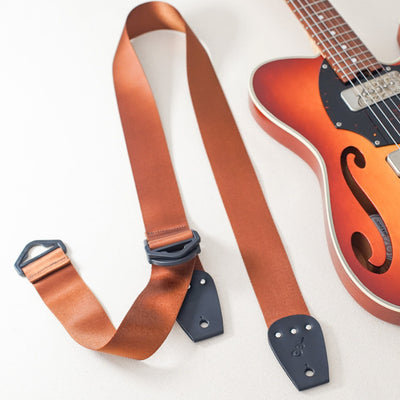
“I want to change the length quickly without stopping my performance”—to answer that request, 708works created the “Courier,” which allows you to adjust the strap length with one hand.

Just pull the strap tab on the back with one hand to shorten it, or pull the tab on the buckle side to lengthen it. You can instantly switch to the optimal position for each song without stopping your performance.
“I wanted to change the height for each song in my live setlist, this is exactly what I was looking for!”
——Comment from a customer who actually used it
👉 Click here for details on the Courier
For those who don't want to compromise on design, there's the “duet”
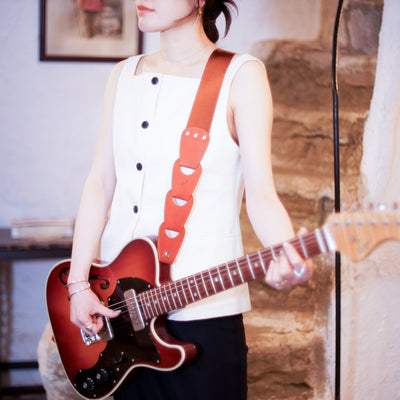
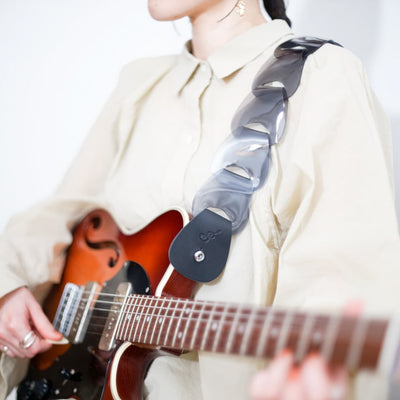
For those who want functionality but are also particular about looks, the duet – CW73R with its beautiful scale pattern design is recommended. It inherits the Courier’s one-handed adjustment function while allowing for fine, stepless adjustments.

“The one-handed adjustment is amazing. I decided this would be my first strap.”
👉 Click here for details on the duet – CW73R
Summary: Get free from the stress of length adjustment
The length of your guitar strap is a crucial element that is directly linked to both ease of play and your visual impression. That is why "playing in a compromised position" is a waste.
If you have felt inconvenienced by conventional straps, please try this new strap that can be adjusted with one hand. You will surely be surprised at the feeling of those small, everyday stresses while playing simply disappearing.
708works is a handmade brand that gives shape to the “if only this existed” wishes of guitarists. You are sure to find the perfect one for your playing style.