Guitar strap making at 708works: Why we are committed to our leather and manufacturing process
Have you ever wondered, "What makes this strap different?"
When looking for guitar straps at music stores or online, have you ever questioned, "They look similar, so why are the prices and textures so different?" Many of you are likely also thinking, "If I’m going to buy one, I want something I can use for a long time that truly reflects my personal style."
708works is a handmade guitar strap brand based in Amagasaki, Hyogo Prefecture. In this article, I will explain how we choose our materials and manufacturing methods, and what we are most particular about—not through abstract theories, but based on concrete facts. By the time you finish reading, you will have one more standard to use when choosing your next strap.
To begin with, why did I start making straps myself?
The origin of 708works was my own frustration as a founder: "I can't find my ideal strap." I used to work for a guitar manufacturer, but even after searching music stores and the internet, I couldn't find anything that felt "just right."
Even when looking at top artists standing on huge stages like Osaka-Jo Hall, the straps they used were mostly very simple. Driven by the thought that "there should be straps that highlight the individuality of the performer more," I drew on the leathercraft experience I had been teaching myself since my student days and started by making one for myself.
That first strap was the prototype for our current braided guitar strap, "Triad." I used it for many of my own band's live shows, but as I continued using it, I began to see areas for improvement. I revisited the materials and specifications many times, and through repeated prototyping and refinement, I arrived at the current design and quality.

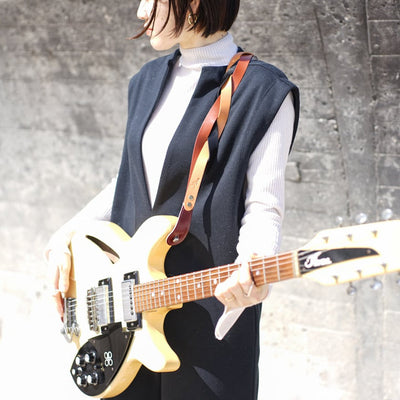
The Triad, made by braiding three cowhide belts, uses highly durable horse vegetable-tanned leather at the connection points with the instrument. This was the result of getting to the bottom of "why a braided structure?" and "why this leather?" The braided design doesn't stand out too much, yet it possesses a presence that mass-produced products simply don't have.
The criteria for deciding, "I’ll buy this leather"
We source our leather from several domestic wholesalers and leather shops. When choosing, we prioritize two things above all else: "consistent quality" and "reliable long-term supply."
No matter how attractive a piece of leather is, if we cannot supply it consistently, we cannot adopt it for our products. We want to avoid the situation where a customer falls in love with a strap but finds it impossible to reorder. When we find a leather that piques our interest, we purchase a small amount to actually manufacture and verify it, and only those deemed to have superior quality and comfort make it into our lineup.
As the founder, I personally prefer leather that has a moderate amount of firmness and tension, and is also easy to work with. I select materials based not just on their visual beauty, but also on the durability required to use them for years to come.

The experience of "that was a failure" in material selection
Of course, I’ve experienced countless failures. Leather with insufficient tensile strength, leather with severe color fading. Even with hardware, there were parts that just didn't "feel right" when assembled.
That is why we always conduct product testing on new materials to confirm their durability and ease of use. And ultimately, I also value my intuition when holding the finished product. Even if a material performs well, I won't use it if I feel it isn't "the one." This stance of "not using materials I don't like" translates directly into the durability and comfort that our customers receive.
Processes we never skip and our trusted tools
One process we always perform is treating the flesh side (the back) of the leather to prevent fuzzing. Neglecting this extra step compromises not only the durability of the product but also the texture when held in the hand. That is why we never skip it for any of our products.
The unsung hero behind our prototyping is the "laser cutter." Because it allows us to engrave and cut leather with high reproducibility based on design data, we can prototype repeatedly until we reach a shape we are satisfied with. Along with industrial sewing machines and tabletop hand presses, every one of these tools is an essential partner.
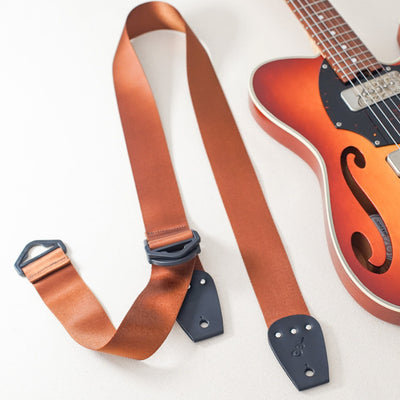
Being a small-scale desktop manufacturer allows us to realize free ideas that are a cut above the big manufacturers. For example, the Courier, which allows you to change the length with one hand during a live performance, is a function-oriented strap born to eliminate performance stress.

We solved the real-world frustration of "wanting to change strap length during a performance" using the durability and practicality of a POM buckle. The product planning experience I cultivated during my time at a guitar manufacturer is what breathes life into these kinds of ambitious creations.
Finally
708works straps are not built on emotion, but on the accumulation of "why we chose these materials and processes." Consistent quality, processing and treatments suited to the materials, and selection based on intuition—all of it is directly linked to the comfort and durability you experience when you use our products.
A strap is a partner that stays with your instrument for a long time. I invite you to experience the quality with your own hands. I am certain you will feel, "This is exactly what I was looking for."